MEMORIAL
The “Railway Bridge Over the Rhine at Breisach in War and Peace” serves as both the conceptual and physical starting point for this remembrance project MEMORIAL.
In October 1940, more than 5,600 Jews from Baden were deported in seven trains from Freiburg over the Breisach railway bridge to the Southern French internment camp Gurs. The project MEMORIAL follows the question: How can these people be remembered? At the same time, it is concerned with other groups that suffered under the Nazi injustice, as well as the significance of memories of wartime and painful experiences in Baden and Alsace from 1870 – 1945.

Since the 1990s, discussions have taken place on both sides of the Rhine about re-establishing a continuous railway connection between Freiburg and Colmar. The project was formalised in the 2019 Aachen Treaty between Germany and France, and planning has been steadily progressing and acts as a current point of reference for the project.
For the Blue House, the key question is how and where to publicly commemorate the deportation of Baden’s Jewish population.
Whether or not a new railway bridge is built has no bearing on the work of the Memorial project. The submissions and ideas collected are not intended as a blueprint for art associated with the construction of such a bridge. Instead, they will form part of a broader remembrance initiative that will continue beyond the project’s official conclusion in December 2025.
The artist Sigrid Sigurdsson learned about the Blue House’s plans and has agreed to act as patron for the Memorial sub-project. Her concept of an “imaginary bridge,” a project for active and participatory remembrance of regional history and the history of the railway bridge at Breisach, will be reviewed, discussed, and further developed by a dedicated project group.
Publisher Dieter Weber has been tasked with coordinating the project group.
As part of the final conference in November 2025, the submitted public proposals were presented on a digital screen.
The video proposal “Pour Tshidibi, for Willi – Two Great-Grandfathers for Rose” from the Munich-based photographer Barabara Hartmann was renowned for its narrative style that reaches across and cuts through borders.
The development of this proposal is presented here:
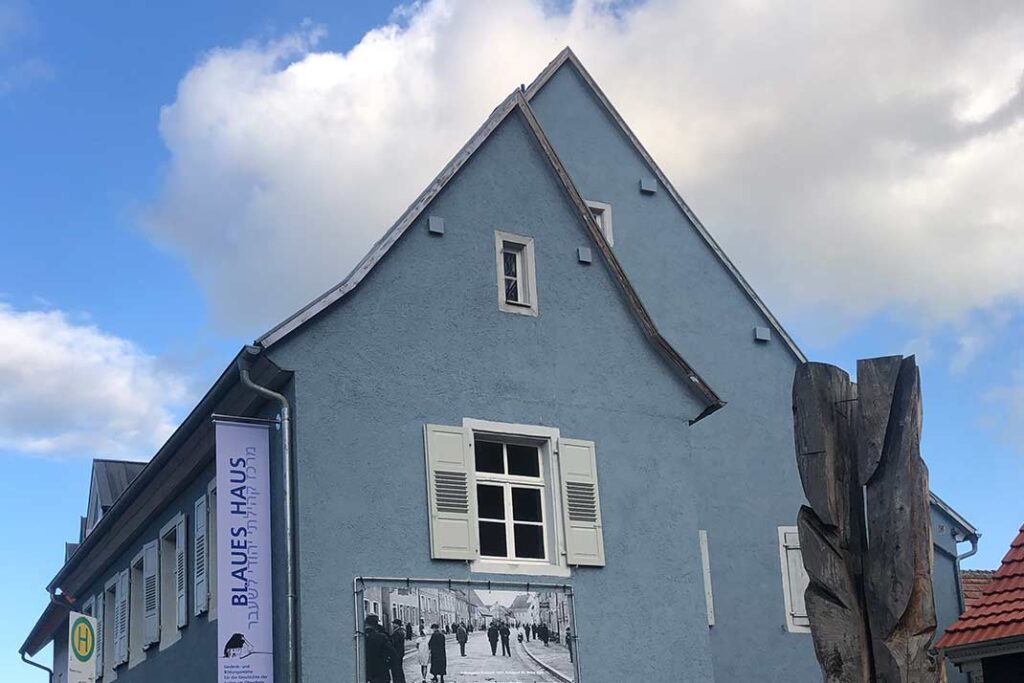
The autobiographical video “Pour Tshidibi, for Will – Two Great-Grandfathers for Rose” came out of an excursion to the Blue House in Breisach and over the Julius-Leber-Bridge. “The End” of the rails that previously led over the bridge, over which the Jews of South Baden were deported, emerges fragmented. My mother and daughter are in the video as they visit the Blue House together. My daughter, age 7, encounters a yellow Jewish star badge and my mother attempts to explain to her what it means. The recording isn’t staged, but rather spontaneously captured with my phone. My mother never met her father and speaks about grief later in the film with her gaze facing towards France. My daughter recounts the everyday racism of the present day – from an experience with a girl that was not allowed to play with her. She can’t make sense of this “exclusion”, yet knows that it happened because of her skin color. Her experience is not comparable to the Jewish persecution, but can be thought-provoking. Rose’s Congolese great-grandfather was a colonial soldier who was forcibly recruited by the Belgians, but was murdered between Strasbourg and Freiburg. Rose’s German great-grandfather was “stationed” in Alsace-Lorraine, where he was also shot. They could have encountered one another. What would have happened? German soldiers didn’t take most “colonial soldiers” captive; they were immediately killed. What would happen if these two men were to encounter each other today? Together with Rose, who is a bridge between them, a child, who happily cartwheels on the bridge between Germany and France and today can freely move here and there. Can the film also give hope for our shared future? Like a bridge can?
The Project Group
Sigrid Sigurdsson
Sponsor of the project “Memorial”, Artist, Hamburg
Gabriele Valeska Wilczek
Blue House Breisach
Co-Project Board “Bridge for the Future – Pont pour l’avenir“
Dieter Weber
Publisher of the art book reader modo press, Freiburg (until 2024)
Coordinator of the project „Memorial“
Christiane Walesch-Schneller
Blue House Breisach
Chairsponsor “Fördervereins Ehemaliges Jüdisches Gemeindehaus Breisach e.V.“
Bernhard Reuter
Blue House Breisach, Colmar France
Sponsor of the “Fördervereins Ehemaliges Jüdisches Gemeindehaus Breisach e.V.“
David Hack
Stadt Breisach
Administrative Archive and Museum for City History
Constanze Schröder
Stadtmuseum Berlin
Administrative Outreach Agency
Jan Merk
Administrator of the Dreiländermuseums Lörrach
Matthias Möller
Leader of the Landing Site for Daily and Regional culture/ South Baden Branch of the Baden State Museum
Jérémy Goltzéné
Art‘Rhena Vogelgrun, France
Head appointee of program planning
Robin Gommel
Artist
DISCOVER MORE